
A/B Test Book Covers with AI for Max Marketing Impact
In the crowded world of publishing, your book cover is your single most important marketing asset. It’s the first thing readers see, and it can make or break a sale in seconds. But as an author or marketer, how can you be sure your cover will drive sales? Relying on gut feelings is a risky strategy when your success is on the line.
This is where data-driven decisions come in. A/B testing, a powerful marketing technique, allows you to replace guesswork with concrete evidence of what your readers truly want. This guide will show you how to leverage A/B testing for your book covers, using the speed and creativity of AI tools. With an AI-powered book cover generator, you can quickly design your covers and discover the one that will maximize your book's impact.
Why A/B Test Book Covers for Higher Sales?
Before diving into the "how," it's crucial to understand the "why." A/B testing your book cover isn't just an academic exercise; it's a direct path to improving your book's visibility and profitability. It shifts the conversation from "I like this one better" to "This version gets 40% more clicks."
Understanding the Basics of Book Cover A/B Testing
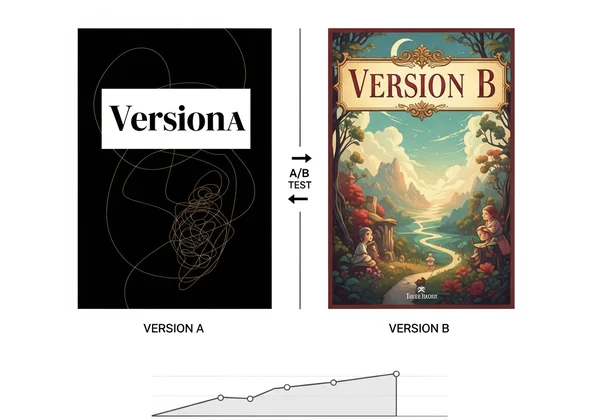
At its core, A/B testing (or split testing) is a simple experiment. You create two or more versions of your book cover, which we'll call Version A and Version B. You then show these different versions to segments of your target audience to see which one performs better based on a specific goal.
The goal could be anything from getting more clicks on a social media ad to generating more pre-orders. By measuring the response, you can definitively identify the more effective design. This process removes personal bias and lets your potential readers tell you exactly what makes them want to learn more about your book.
The Impact of Cover Design on Reader Engagement and Sales
Think of your book cover as the packaging for your product. In a physical bookstore, a striking cover pulls a book off the shelf. Online, it has to stop a reader from scrolling past hundreds of other titles. A single design element—a color choice, a font style, or an image—can dramatically influence a reader's perception.
Your cover should shout your book’s genre and mood at a glance. It builds expectations and hooks readers emotionally. A cover that is A/B tested and proven to be more engaging will lead to a higher Click-Through Rate (CTR) on ads, more visits to your book’s sales page, and ultimately, a direct increase in sales and read-throughs.
Generate & Prepare AI Book Cover Designs for Testing
One of the biggest historical barriers to A/B testing covers was the cost and time required to produce multiple professional designs. Commissioning a designer for two or three distinct concepts could be expensive and slow. This is where artificial intelligence changes the game entirely.
AI-powered tools solve the prototyping problem. Authors and marketers can now generate high-quality cover options in minutes. This makes A/B testing easy, affordable, and scalable.
Crafting Multiple Cover Variations with BookCoverDesign.ai
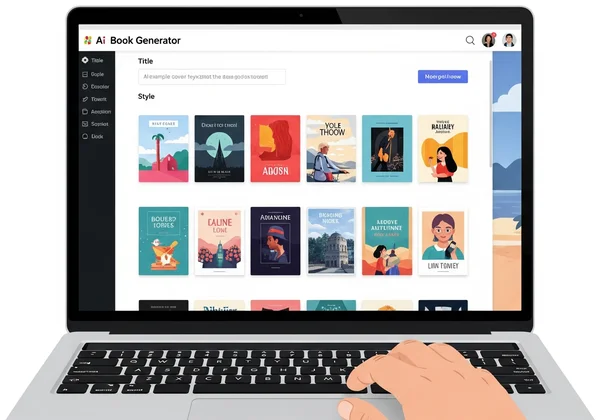
Using an AI book cover generator is a straightforward process designed for efficiency. With a tool like BookCoverDesign.ai, you can create endless variations to test. Simply enter your book title, choose a style template like "Minimalist Elegance" or "Illustration and Pop Art," select a color theme, and write a detailed prompt describing your vision.
Want to test a character-focused cover against a symbolic one? Or a dark, moody color palette against a bright, optimistic one? You can generate both in minutes. This ability to quickly produce different concepts is the key to effective testing. To get started, you can start generating variations right now and see how easily you can bring multiple ideas to life.
Ensuring Your AI Covers are Ready for A/B Testing
Once you have your AI-generated cover designs, you need to prepare them for a fair test. To get clear and reliable results, it's best to test one significant variable at a time. For example, if you want to see which color scheme works best, keep the imagery and typography the same across your test versions.
If you are testing different imagery, keep the colors and fonts consistent. This approach helps you isolate what element is truly influencing your audience's behavior. Also, ensure all test versions are exported in the correct format and resolution for the platforms where you'll be running your experiments.
Strategic Book Cover Marketing Through A/B Testing
With your cover variations ready, the next step is to put them in front of your target audience. This is where book cover marketing strategy comes into play. Choosing the right platform and setting up your test correctly will ensure the data you collect is meaningful and actionable.
Choosing Platforms to Run Your Book Cover Experiments
There are several excellent platforms you can use to A/B test your book covers, each with its own advantages.
-
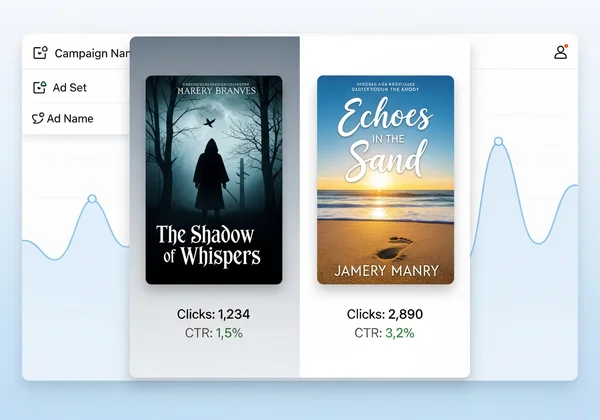
Social Media Ads (Facebook, Instagram): This is one of the most effective methods. You can run two identical ads, changing only the book cover image, and target them to your ideal reader demographic. The platform's analytics will clearly show you which cover gets more clicks. We’ve found that testing covers for specific genres, like thriller or romance, on these platforms yields highly actionable data.
-
Email Newsletters: If you have an author mailing list, your subscribers are your most engaged audience. You can send an email with a simple poll asking them to vote for their favorite cover.
-
Reader Polling Services: Websites like PickFu allow you to get fast feedback from a targeted audience for a small fee. This is a great way to get unbiased opinions from people who fit your reader profile.
-
Social Media Polls: Use the poll features on platforms like Twitter or Instagram Stories for a quick and informal way to gauge general audience preference.
Setting Up Effective A/B Tests: Metrics and Audience
To run a successful test, you need to define what success looks like. The most common metric for ad-based tests is the Click-Through Rate (CTR). A higher CTR means the cover is more effective at grabbing attention and making people want to learn more. For polls, the winner is simply the one with the most votes.
Equally important is your audience. Ensure your test is shown to people who would actually read your book. Testing a romance cover on a group of horror fans won't give you useful data. Use the targeting features available on ad platforms to narrow your audience by interests, age, and other demographics relevant to your genre.
Optimize Book Cover Sales: Analyze & Implement Results
Running the test is only half the battle. The real value comes from analyzing the data and using those insights to make a final, confident decision. This is the step that allows you to truly optimize your book cover for sales.
Interpreting Your A/B Test Data: What Do the Numbers Say?
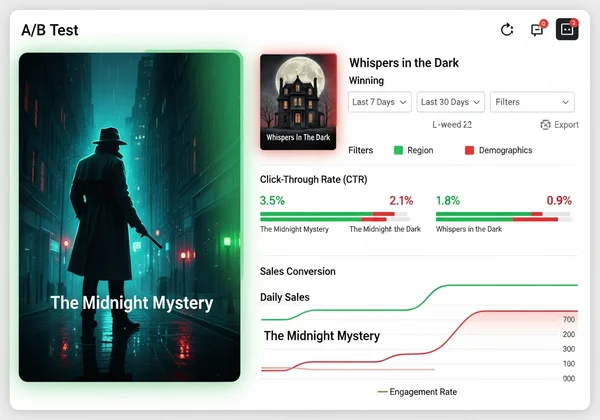
Once your test has run its course, it’s time to look at the results. In an ad campaign, one cover will likely have a higher CTR or a lower cost-per-click. In a poll, one will have a clear majority of votes.
Look for a decisive winner. If Version A gets a 5% CTR and Version B gets a 2.5% CTR, you have a strong signal that Version A is more effective. If the results are very close (e.g., 51% vs. 49% in a poll), the difference may not be significant, and you could either run a larger test or choose based on secondary factors. Trust the data, especially when it surprises you.
From Insights to Action: Implementing Winning Cover Designs
Once you’ve found your winning cover, use it everywhere. Update your website, social profiles, and ads with this proven design.
By taking this final step, you are launching your book with a cover that has already been validated by your target market. You've moved beyond hope and into a strategy backed by evidence, significantly increasing your book's chance of standing out and achieving commercial success.
The Bottom Line
Imagine launching your book with a cover proven to grab readers—not just one you hope works. That’s the power of data-driven design. A/B testing transforms your cover from a piece of art into a high-performance marketing tool, ensuring it connects with readers and drives them to click "buy."
The rise of AI has made this powerful strategy accessible to everyone. With the ability to generate countless professional designs in minutes, you can test, learn, and optimize like never before. Replace uncertainty with evidence: test your covers, listen to readers, and launch with confidence.
Ready to discover the perfect cover for your book? Create your book cover today and find the design that truly captivates your audience.
Frequently Asked Questions About A/B Testing Book Covers
Designing Covers for Testing
How can I design a professional book cover for A/B testing?
The fastest and most cost-effective way is to use a specialized tool. An AI book cover generator gives you access to market-aware styles and professional-grade design elements without needing any design skills. You can create multiple high-quality options in minutes, perfect for testing. You can get a professional design instantly to start your experiments.
Key Elements for Success
What elements make a book cover successful in A/B tests?
Successful covers typically feature a clear, easy-to-read title, compelling imagery or graphics that evoke the book's genre, and a color palette that sets the right mood. Crucially, the design must be effective even as a small thumbnail, as that's how most online readers will first see it. A/B testing helps you find the perfect balance of these elements.
The Role of AI in Testing
How do AI book cover generators help with A/B testing?
AI book cover generators solve the two biggest challenges of A/B testing: time and cost. Instead of paying a designer for several concepts and waiting weeks, you can generate numerous variations yourself in a single afternoon. This empowers you to test more ideas, gather more data, and ultimately make a much more informed decision about your final cover design.