
Why AI Book Covers Need a Thumbnail Check
An AI cover can look striking when it fills your screen. Then it shrinks to storefront size and suddenly the title is muddy, the subtitle vanishes, and the art turns into visual noise. That is one of the most common reasons authors choose the wrong draft too early.
A fast AI book cover generator is excellent for exploring concepts. It can help you test mood, genre cues, typography direction, and image ideas quickly. But the strongest concept is not always the one that survives at thumbnail size.
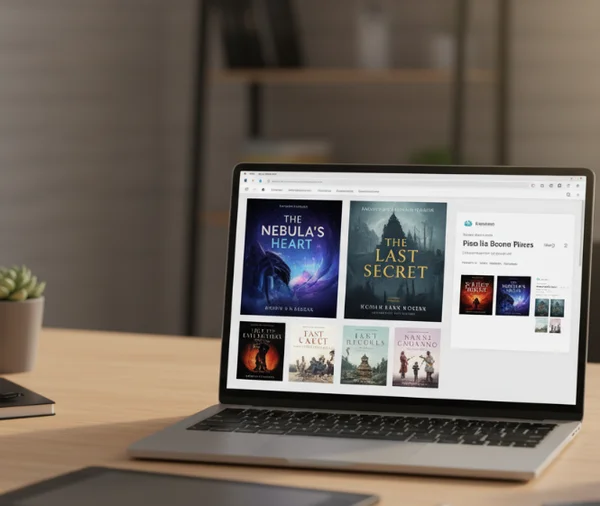
The Full-Size Mockup Looked Great, but the Thumbnail Disappeared
Why title contrast matters more than decorative detail
When readers browse digital storefronts, they do not meet your cover at poster size. They meet it as a small rectangle competing with dozens of others. That changes the design problem. Fine texture, subtle gradients, and layered symbolism may still matter, but only after the title and main visual signal remain readable.
The University of Oregon says text should reach a 4.5:1 contrast ratio. Large text and essential graphical elements can use 3:1 (University of Oregon accessibility guidance). A book cover is not a compliance form, but the principle still helps. If the title melts into the background at small size, the design is asking too much from the reader.
That does not mean every cover needs harsh black-on-white lettering. It means the title, author name, and key image should separate clearly enough that the eye knows where to land first. A cover concept workflow becomes more reliable when you judge drafts at small size, not only at full zoom.
Why one focal point beats three competing ideas
Many AI drafts fail because they try to sell everything at once. A castle, a moon, a face, a weapon, glowing fog, floating symbols, and stylized typography can each look impressive on their own. Together, they often collapse into clutter.
At thumbnail size, the eye usually wants one dominant read. Maybe it is the title. Maybe it is a silhouette. Maybe it is a color block with one memorable symbol. If 3 visual ideas are competing at equal strength, none of them wins. The cover may look “busy” instead of purposeful.
A Simple Thumbnail Check Before You Keep or Discard a Design
The zoom-out test for title, image, and subtitle hierarchy
A practical check is simple. Shrink the draft until it feels closer to an online store preview. Then ask 3 questions. Can you still read the title without squinting? Can you tell what genre mood the image is signaling? Can you still tell whether the subtitle matters, or should it be reduced or removed?
This is where a book cover design tool can help. It lets you compare several directions quickly instead of getting emotionally attached to one polished-looking image. In many cases, the winning thumbnail is not the fanciest one. It is the one with the clearest hierarchy.
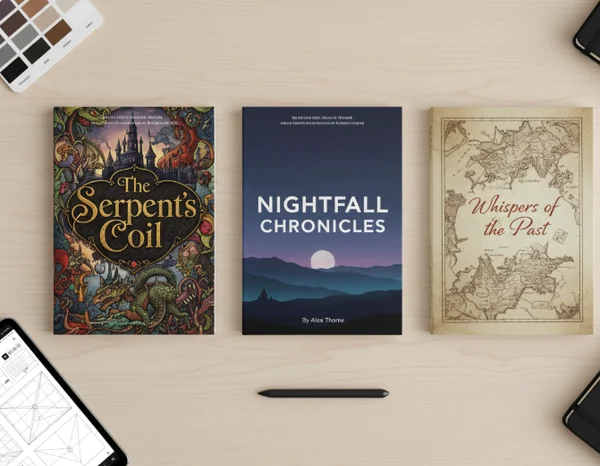
Another useful check is to view 2 or 3 candidate covers beside each other. If one cover stays legible from farther away, that is not a minor advantage. It is often the difference between a cover that gets ignored and one that earns a second look.
When ebook-first logic should win over poster-style artwork
Some covers are mainly fighting for attention in digital storefronts, email graphics, and mobile screens. In those cases, ebook-first logic usually deserves more weight than poster-style complexity. A dramatic full-screen illustration may be beautiful, but it can be the wrong choice if the title disappears on a phone.
That is especially true for new authors who do not yet have strong name recognition. If readers are discovering the book for the first time, the cover must communicate genre and title fast. Readability usually beats intricacy in that moment.
How to Use AI Cover Drafts Without Assuming They Are Print-Ready
What 300 dpi, CMYK, and bleed change
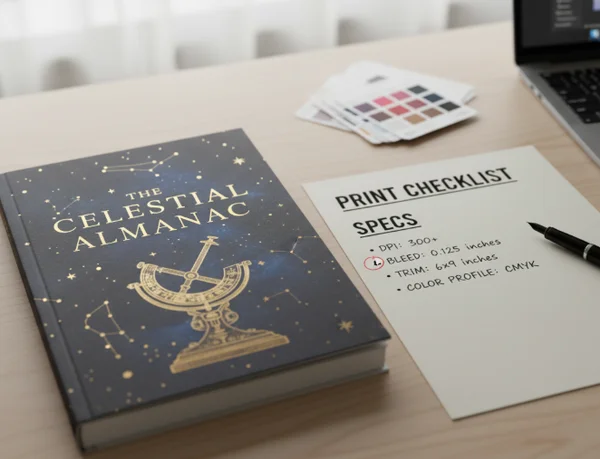
A generated cover image can be a strong concept draft and still be unprepared for print. University of Delaware Printing says 300 dpi is best for printing and that CMYK is preferred over RGB color mode (University of Delaware Printing). That matters because a draft that looks sharp on screen can still soften, shift color, or break down once it moves into print production.
The same guide also notes that elements meant to print to the edge should bleed one eighth of an inch beyond final trim. That is a small measurement, but it has a big practical consequence. If your composition depends on delicate edge details, you need to know exactly what can be trimmed away.
What to verify before exporting for templates
This is where authors should slow down and stop treating the generator as the final production system. MSU Libraries notes that Amazon KDP's cover calculator can generate cover dimensions and a downloadable PDF template. Trim size and margins still depend on page count (MSU Libraries self-publishing guide). In plain terms, the right print layout depends on the actual book format, not just on what looked good during concepting.
So the smarter workflow is to use AI for exploration first. Find the strongest concept. Test it at thumbnail size. Then verify print dimensions, bleed, spine space, and export requirements against the template for your real format. That keeps the speed advantage of AI without pretending the draft is automatically ready for every distributor.
What to Remember Before Choosing Your Final AI Book Cover
A great AI cover is not only attractive at full size. It also stays readable when it shrinks, keeps one clear focal point, and survives the boring production checks that publishing still requires.
Thumbnail testing belongs near the end of your decision process, not as an afterthought. If two covers feel equally strong, the better choice is often the one that reads faster, scales down better, and needs less rescue work before export.
Use the generator to explore more directions, not to skip judgment. The best draft is the one that looks good at a glance, still feels on-genre, and gives you a cleaner path into the final production template.